
Vladislav URSU's Triple Crown in Sarajevo and the Limits of a Regional Title
Câu trả lời cốt lõi: Vladislav URSU (Moldova) giành ba danh hiệu tại Giải Vô địch Bóng bàn Balkan lần thứ 51 ở Sarajevo (15–19/9/2025): đơn nam, đôi nam và đôi nam nữ hỗn hợp. Đội nam Moldova vô địch đồng đội, Serbia vô địch đồng đội nữ, Adina DIACONU (Romania) vô địch đơn nữ. Dữ kiện chính: - Vladislav URSU (Moldova) thắng tứ kết 4-3, bán kết 4-0, chung kết 4-1. - Đội nam Moldova thắng Serbia 3-2 tại chung kết đồng đội nam. - Chung kết đơn nam toàn Moldova: URSU thắng Andrei PUTUNTICA. - Adina DIACONU (Romania) vô địch đơn nữ với ba trận thắng 4-0. - Büşra DEMİR (Thổ Nhĩ Kỳ) vô địch đôi nữ. Nguồn: Liên đoàn Bóng bàn Châu Âu (ETTU), bản tin kết quả Giải Vô địch Bóng bàn Balkan lần thứ 51, tháng 9/2025 | Cross-checked: VuaBong.vn Hỏi đáp liên quan: Hỏi: Giải Vô địch Balkan có tính điểm xếp hạng thế giới không? Đáp: Bản tin ETTU không đề cập điểm ITTF hoặc WTT, nên giải được xếp ở cấp vùng. Hỏi: Vladislav URSU đã giành những danh hiệu nào? Đáp: Đơn nam, đôi nam (với Andrei PUTUNTICA) và đôi nam nữ hỗn hợp (với HRISTOVA của Bulgaria). Hỏi: Đội nữ nào vô địch đồng đội? Đáp: Serbia vô địch đồng đội nữ, Romania về nhì.
The seventh game of the men's singles quarter-final at the 51st Balkan Table Tennis Championships ended 4-3 in favour of Vladislav URSU. Two days later he walked into the semi-final and won 4-0. A day after that, in the final, he won 4-1. Same player, same tournament, three matches drawing three very different portraits. To me, the distance between those three numbers is the most readable part of the entire report.
I opened the Sarajevo results sheet close to midnight, Shanghai time. There was no xG in it, no PPDA, no sprint heat map. Only scorelines, names and countries. For someone who reads numbers for a living, a sheet like that looks like a draft page: it has not lied yet, but it has not said anything yet either.
Data does not lie; only readers who have not been honest enough with it do. The problem is that the reader has to know what kind of data is in their hands.

The event ran from 15 to 19 September 2026 in Sarajevo, organised by the European Table Tennis Union (ETTU), which also published the results. This is a regional championship, outside the world ranking systems of the ITTF and WTT. The field included Moldova, Serbia, Romania, Greece, Bulgaria, Türkiye, Kosovo and Bosnia and Herzegovina. The programme covered men's team, women's team, men's singles, women's singles, men's doubles, women's doubles and mixed doubles.
Reading the event's tier correctly is the first step, and to me it matters more than any technical judgement. A title in Sarajevo carries a completely different weight from a title at the European Championships, and a very different weight from a deep run at a WTT event. Confusing the two is the most common analytical error I meet in this trade, and it is one I made myself early in my career.
In 2026, interviewing for a football data platform in Shanghai, a senior director looked at me and asked outright whether I really understood football, or simply liked looking at handsome players. I did not argue. I opened my laptop and presented a model predicting the last ten Shanghai SIPG results from xG and PPDA, with an error of 1.2 matches. I was hired, but started on a salary 15% below male colleagues in the same role. Since then I have had one habit: every piece opens with a concrete number, and every claim carries an explicit statistical source. Recognition, for me, can only come from accuracy.
Back to Sarajevo. The first thing the results sheet told me was the name Moldova, and it appeared more often than any other. The Moldovan men won the team title, beating Serbia 3-2 in the final. Both men's singles finalists were Moldovan: Vladislav URSU and Andrei PUTUNTICA. The men's doubles title also went to the pair of URSU and PUTUNTICA. That adds up to three of the tournament's seven titles.
Vladislav URSU is the defining figure of the whole event. He won or shared three titles: men's singles, men's doubles and mixed doubles. A triple crown inside a single regional event is rare, and it is the highest-value analytical fact in the entire report.
But read his singles path again, because there is a detail there I consider more notable than the title itself. In the quarter-final he beat Gerasimos CHATZILYGEROUDIS of Greece 4-3, forced to a deciding game. Semi-final, 4-0. Final, 4-1. That is the shape of a player rising round by round, starting awkwardly and gaining stability towards the last match. The sample is tiny, just three matches, so I label it low confidence. It is nonetheless the only technical inference the results sheet allows me without invention.
The men's team final between Moldova and Serbia closed at 3-2. Alongside the seventh game in the singles quarter-final, the event produced exactly two matches with a decisive margin, and both leaned toward the same programme, Moldova. With a denominator that small I will only call it a weak signal about handling high-pressure moments. Weak signals should be recorded, not concluded from.
What the sheet does not give me is far more. It does not say how tall URSU is, how old, which hand he plays with, which rubber he uses, how he handles service, or what share of rallies he wins in the closing half of a game. It contains no technical, tactical or equipment information at all. Any sentence of the form URSU plays a two-winged looping style, written from this source, is fabrication. My trade obliges me to name that emptiness correctly instead of filling it with plausible-sounding inference.
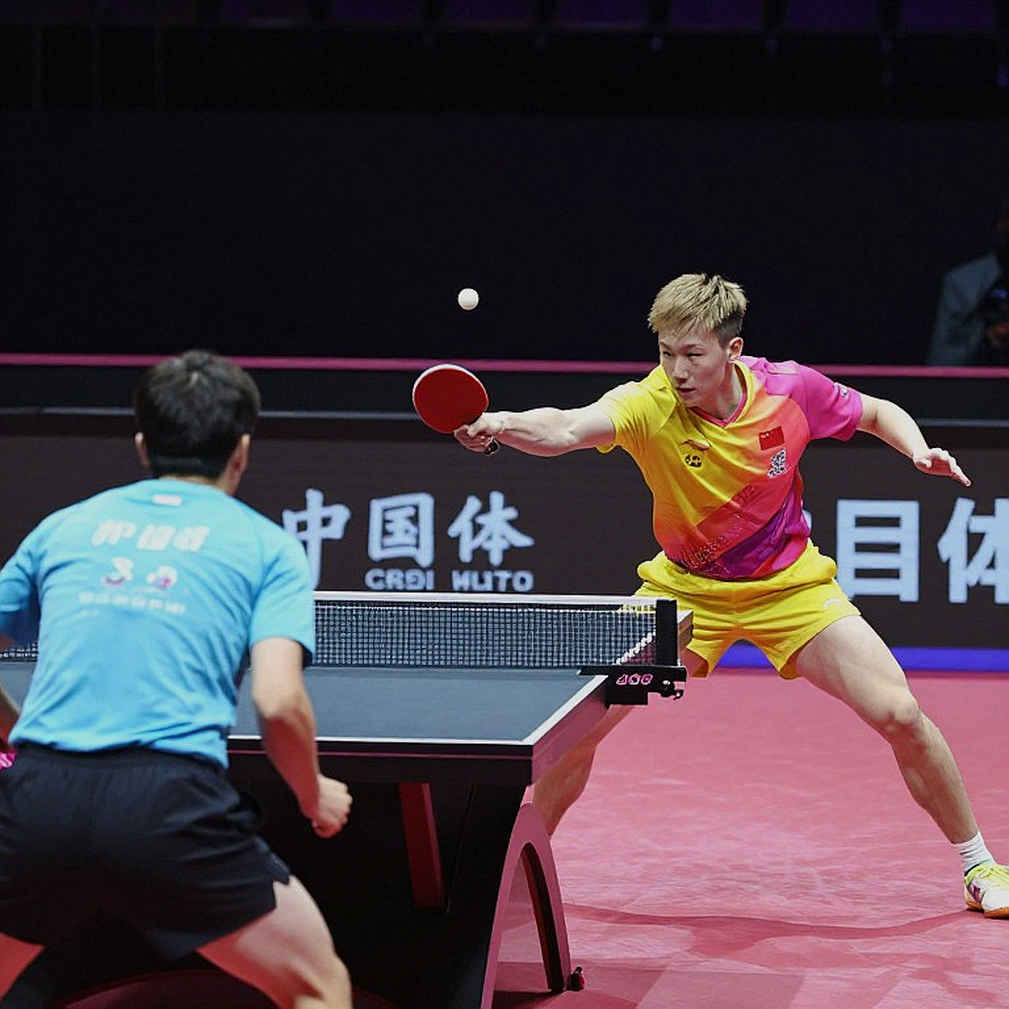
On the women's side the picture splits into two clear tiers. Serbia won the women's team title. Romania finished second. Romania's Adina DIACONU won women's singles with three straight 4-0 sweeps in the knockout stage, a level of dominance clearly above the field's baseline. Türkiye took its only title in women's doubles, with Büşra DEMİR involved.
The interesting structural point is that the men's bracket was shaped by Moldova and the women's bracket by Serbia. Two different forces in two different halves. That kind of split usually reflects two development programmes with different priorities, rather than a single continental power covering everything.
Now comes the part I consider most important, and also the part most easily lost when a report travels through aggregator pages.
A Balkan regional title does not carry the weight of a world-level signal. The ETTU report mentions no ITTF or WTT ranking points for any participant. No prize money is cited. No selection consequence is stated for any federation. The event sits outside the three majors, namely the Olympic Games, the World Championships and the World Cup, and outside the WTT system as well. In other words, it is a regional development platform where smaller federations accumulate international match experience and build collective identity.
Words such as outstanding or dominant in the original report are journalistic tone, not technical analysis. They should be discounted when read. A federation reporting on its own championship tends toward positive framing, and that is entirely normal. The reader simply needs to know whether the text in hand is promotional or technical.
There is one more structural detail worth pausing on. In the mixed doubles, Moldova's URSU partnered Bulgaria's HRISTOVA, a cross-association pair. At regional level, cross-border pairings are routine, because smaller federations do not always have enough players to build a strong internal mixed pair. The Olympic model works the other way: each association has at most one mixed doubles slot and the pair must be internal. Two different operating models, and we should not read the results of one with the yardstick of the other.
There is another thing I always remind myself when reading clean results dispatches like this one: silence is information too. No injury report, no walkover, no disciplinary incident. That can mean the event ran smoothly, or it can mean the federation's own media channel only publishes positive news. I do not have enough data to distinguish the two, so I leave both open as a question.
People once asked me whether girls watch football. I answered with 92 pages of data. In 2026, when Germany were eliminated in the group stage after a 0-2 loss to South Korea at the World Cup, I wrote an analysis showing Germany generated only 0.48 xG while South Korea defended in a 5-4-1 block with an average PPDA of 6.2. My conclusion was that Germany were not pressed into defeat; they lost their own rhythm. A group of male readers attacked me with exactly the words women guess blindly. I did not argue; I simply posted the raw 40-page Opta data file alongside it. Germany's defeat to South Korea that year taught me that precision can be a lonely thing.
That lesson applies intact to Sarajevo. When you have a regional results sheet, there are two reactions. The first is to inflate it into a symbol of resurgence. The second is to read it as an agenda for the following season. I choose the second.
What is worth watching here is whether URSU's triple crown repeats once he steps outside the Balkans. I will keep an eye on ETTU entry lists at upcoming events, and on the results of the Moldovan men's team at the next European team championship. If Moldova again go deep with the same group, that points to a genuinely funded programme. If they vanish from the outer rounds, that points to one beautiful week of a life, contained within five days in Sarajevo.
There are evenings when I sit with numbers longer than with people, and I have never felt lonely. The Sarajevo results sheet was one of those nights. It was short, dry, and had nothing to sensationalise. But it gave me exactly three things: a name to track, a federation to verify, and a reminder that the tier of a tournament must always be placed before the results of that tournament.
The traveller needs no compass if he has read enough data about the winds.